
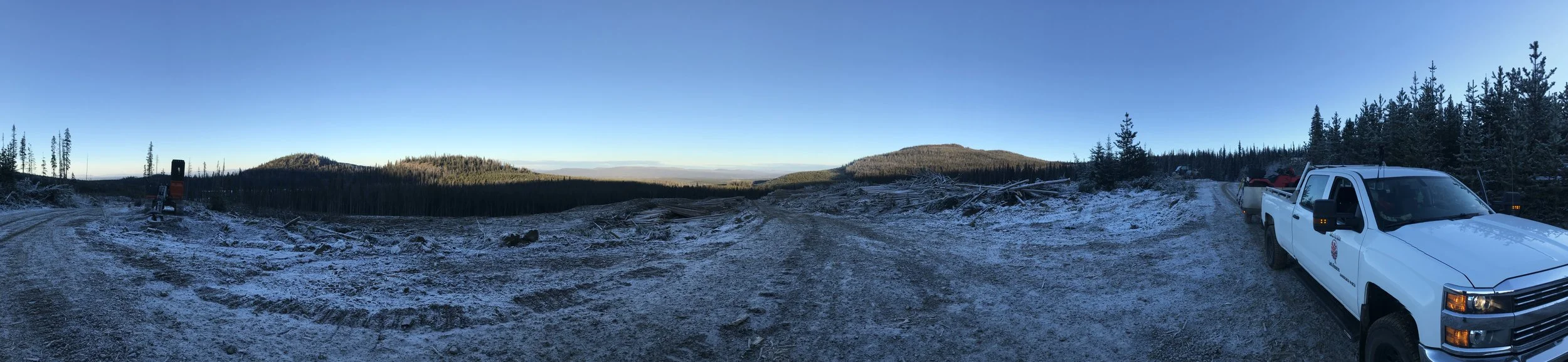
The District of Vanderhoof and Saik’uz First Nation announced a collaboration to manage their community forest and traditional territory in a July 7th press conference, experimenting with sustainable forestry practices, and putting the value of the land as a top priority. They’ve done this under the heading, “Call for Innovative Local Forestry Solutions to Sustain Forests and Protect Regional Jobs.”
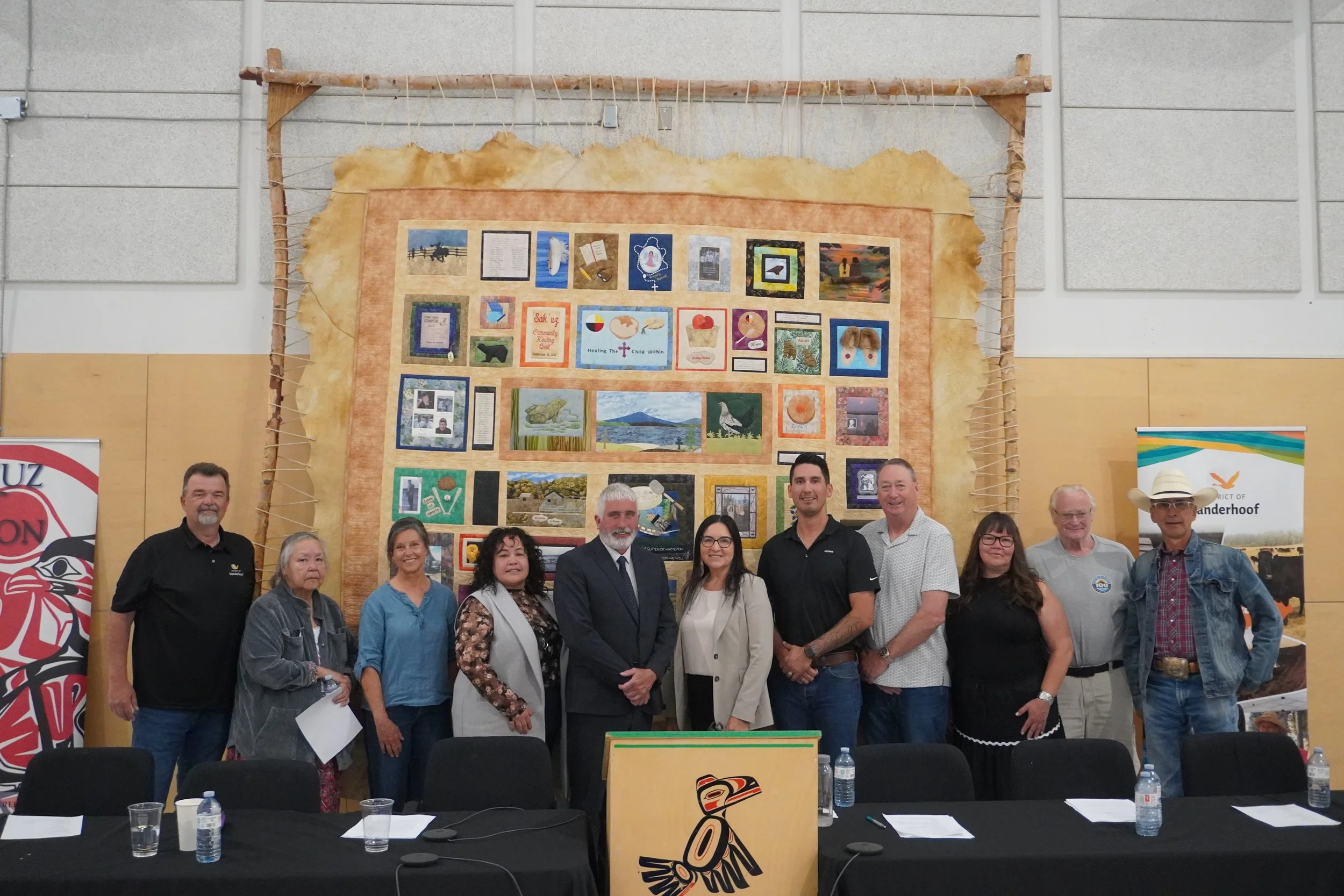
Members of Saik’uz First Nation Council, and District of Vanderhood Council, gather for a photo during a July 7th press release to announce their collaborative approach to call for innovative local forestry solutions to sustain forests and protect regional jobs. Centre Right: Saik’uz Chief Priscilla Mueller. Centre Left: Vanderhoof Mayor Kevin Moutray.
Photo Credit - Saik'uz First Nation
Vanderhoof Mayor Kevin Mountray and Saik’uz Chief Priscilla Mueller spearheaded the announcement of their partnership, presenting a forest management and fibre supply model intentionally different from that of publicly traded corporate methods that have played large roles in the regional forestry industry for decades. With it, alongside many goals, the collaboration intends to put the interest of the land itself ahead of monetary interests, and continue to supply the Nechako Lumber Co. mill with the hope of restoring its workforce back to two full shifts.
This announcement occurred soon after four regional First Nations, including Saik’uz, Lheidli T’enneh, Stellat’en, and Nadleh Whut’en purchased the industrial site further to the west of downtown Vanderhoof, dubbing it the Ncha Koh Industrial Park. The site includes the shuttered Plateau Sawmill, formerly owned by Canfor. When that site closed in 2024 it represented a loss of not only jobs, but hundreds of thousands of dollars of tax revenue to the District of Vanderhoof, so seeing activity in the park again is economically encouraging. Saik’uz Chief Priscilla Mueller made it clear that reopening the Plateau Mill is not on the table for now, “To build a new mill… I think those days are over, but we do have one mill here that we could keep going, and we could keep the families working.”
We spoke to John Rustad, the MLA for BC’s Nechako Lakes District on the subject of the two collaborative developments. He finds the Saik’uz & Vanderhoof joint approach along with the Industrial Park purchase encouraging, but cited a high cost of wood fibre. His outlook is dubious when it comes to attracting further investment, “...the cost of doing business in British Columbia is just so prohibitive, that it’s going to be interesting to see how this First Nation consortium along with Vanderhoof are going to look at trying to do business differently in British Columbia and to get around that cost structure this government has imposed on our forest sector.”
Politics aside, the way Vanderhoof & Saik’uz are approaching business does appear to be different than what has been practiced by the large publicly traded corporations that have withdrawn many investments from the region, intending to restore local forest health, and direct the economic benefits of harvesting locally.
In a way this style of industrial forestry practices sounds similar to the region’s economic landscape of the 1950s to 1970s, where smaller operations were predominantly locally owned, and contributed primarily to the local economy. Local entrepreneur John Brink granted us some perspective that was informed by experiencing the industry first hand in that time frame, who said of the comparison, “...this does not even come close to comparing to the mid 60s…” The amount of raw materials available to harvest, and the regulatory framework that is being operated in has changed dramatically. Mr. Brink referred us to his own interview with BC Forest Minister Ravi Parmar, where among other things, they discussed the possibility of moving from the current volume based, to area based forest management.
In Saik’uz & Vanderhoof’s press statement, Mayor Moutray was quoted, “We are calling on the Province to respect local land use priorities, including the Nation's land use planning work, and embrace collaborative decision-making. Forestry decisions must account for cumulative impacts, wildfire risk, changing forest conditions, biodiversity concerns, long-term sustainability, and local opportunities.” We’ve asked the Forest Ministry whether this described approach aligns with the area based management spoken of by Minister Parmar. Regardless, as Saik’uz & Vanderhoof advance in their collaboration, the experience will determine how well their direction aligns with the Provincial Government’s policies.
Our guests made it clear that the partnership will face challenges operating in the current forestry landscape, but as Saik’uz Elder Marolyn Antoine indicated after describing how much of Saik’uz’s traditional practices have suffered as a result of poor forestry practices, it’s a challenge worth addressing, “...and today we’re working with Vanderhoof. Collaborating. Working with them so that in the future there's something there for our children.”
- Ian Gregg, CFURadio 88.7FM, Due North News, Local Journalism Initiative Reporter
Check out more of our stories on FrequencyNews.ca
Podcast subscription URL for your podcast app (RSS):